Research & concept
1. Discovery & Selection
From Individual Research to a Shared Muse
The project began with a divergence phase where each team member conducted deep-dive research into a different potential user. We took part in participatory interviews, trigger exercises and a probe technique during our individual research phases. This process generated a wide variety of insights and potential design directions, which we then shared and discussed as a team. We used affinity mapping to cluster our findings and identify common themes, which helped us to select our final user for the project.
After comparing our findings, we selected "Lucy" as our finalist. Her profile offered the most unique design challenge: she is a "student living abroad for the first time" with a distinct "family trait of traveling together for a week every summer". However, simply giving her a gift wasn't enough; her specific values around effort and emotional investment made her the perfect candidate for a complex, gamified solution.
2. User Research & Insights
Decoding "Lucy"
(Note: The user's name has been changed to "Lucy" to protect her privacy due to the highly personal nature of the insights.)
To design something meaningful, we had to deconstruct Lucy's personality and values. She is defined as "The Experience Architect", a 19-year-old who values the journey more than the result.
The Persona:
Lucy is family-oriented but competitive. She loves "board games," specifically "deck-building strategy games".
The Friction Point:
She explicitly dislikes gifts that lack effort, believing that "the depth of a relationship is truly measured through emotional investment" rather than material cost. She views quality time as a "scarce and cherished resource".
The Opportunity:
Because she enjoys "finding new ways to add twists to familiar games", she was the ideal recipient for an experience that required her to "earn" her reward.
Key Insight:
For Lucy, a standard email with flight tickets would feel "hollow". The unboxing needed to use "positive friction" to stimulate her curious and competitive nature.
3. Design Vision
Gamifying the Connection
Our design goal was to create a "uniquely interactive and playful gift-unwrapping experience centered around her hobbies and interests". To guide our ideation, we formulated several specific "How Might We" questions:
- HMW inspire the curious Kristi with a playful experience that makes her explore a new challenge?
- HMW make a challenging experience that stimulates her competitiveness, so that Kristi feels rewarded at the end?
- HMW use elements from her hobbies to make the experience familiar?
- HMW provide the family-oriented Kristi with a genuine emotional experience that supports connections and sense of belonging through bridging the distance with her family?
4. Ideation & Final Concept
Diverging and Converging on the Perfect Solution
Our ideation process was rigorous, involving multiple rounds of creative techniques to generate a wide breadth of ideas before narrowing down to our final concept.
Diverging:
- Weird Connections: We started by generating over 20 abstract ideas by randomly combining unrelated words (e.g., "seal," "checkerboard," "passport"). This led to wild concepts like "1v1 seal in checkers" and "Find your passport while a snake is chasing you".
- Mind Mapping: To ground our ideas back in reality, I created a mind map centered on Lucy's core traits and hobbies. This generated ideas more closely tied to her personality, such as "Just Dance with family narrators" and "Where's Waldo on destination landmarks".
Converging:
- Rose, Bud, Thorn: We used this method to quickly filter ideas. "Roses" included strong contenders like "Digital Escape Room" and "Where's Waldo". "Thorns" were discarded ideas like "Carve an airplane on an apple".
- Evaluation Matrix: To select the finalist, we rated our top ideas against our original HMW questions. The "Where's Waldo" concept scored a perfect 6/6 because it combined her love for games, family, and travel into a single cohesive experience.
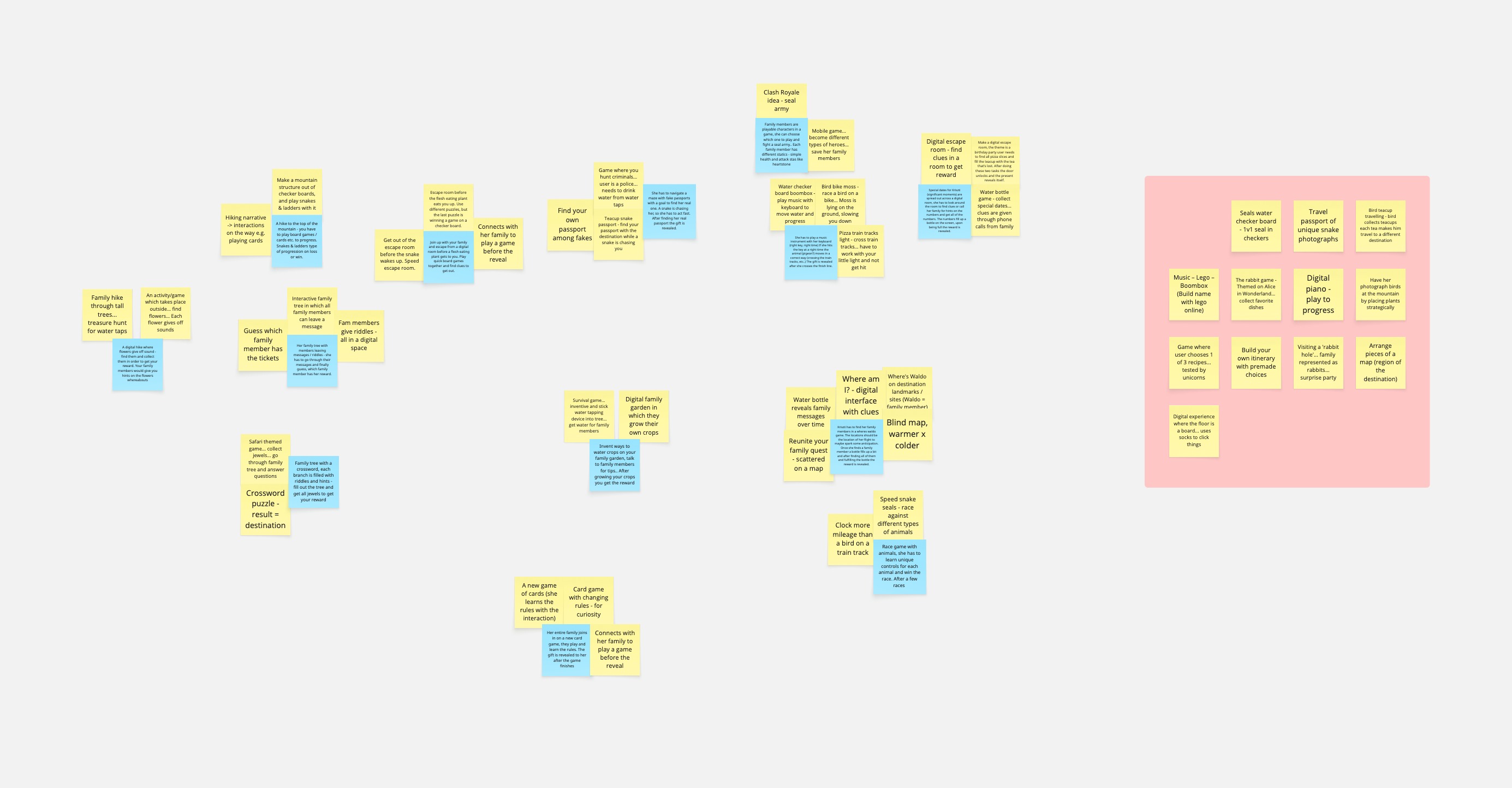
Clustered ideas formed into concepts
Evaluation:
- Dot voting: As we were tasked to narrow down our ideas to 3 finalists, we used dot voting to capture the team's preferences. Each member had 2 votes to distribute among the concepts, which helped us identify the most promising ideas based on collective intuition and initial reactions.
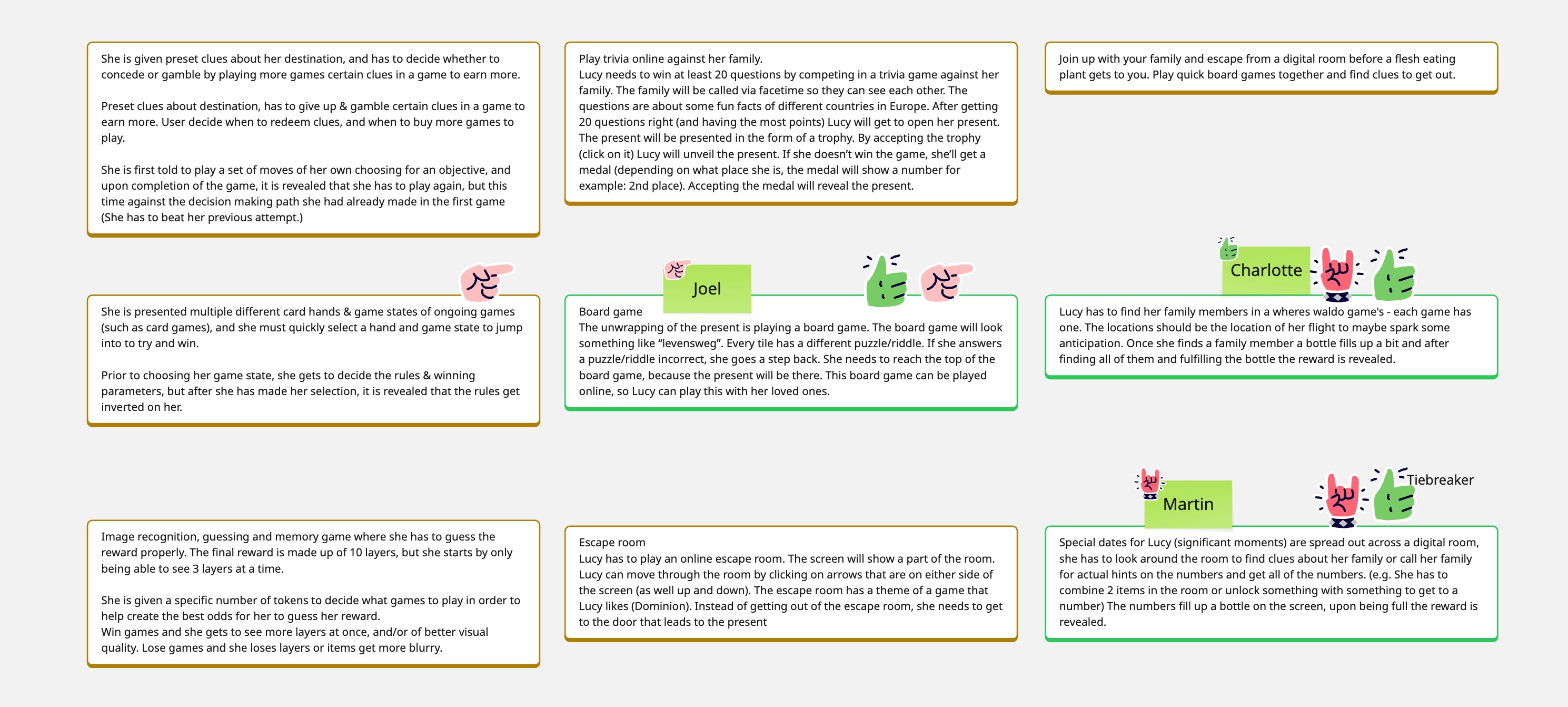
Dot vote results for the top 3 concepts - determining our finalists
Storyboarding:
We each created a storyboard of a potential user journey for our top 3 concepts. This allowed us to visualize how the experience would unfold and identify which idea had the most potential for a compelling narrative and engaging user flow.
The Concept: "Where's the Family?"
We developed a digital scavenger hunt set in Paris. This aligned perfectly with her profile:
- Travel: It foreshadows the actual gift—tickets for a family trip to a new place.
- Competition: It mirrors her love for strategy games where she can "control and plan the experience".
- Connection: Since everyone in her family lives in different countries, the game digitally reunites them before the physical reunion.
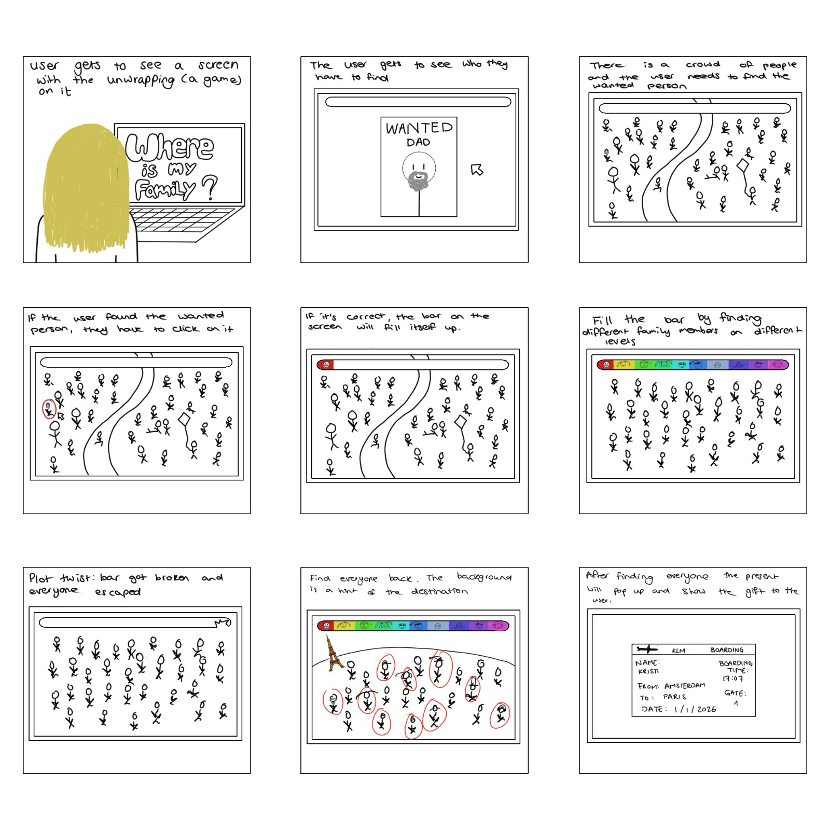
Storyboard of the final concept
Prototyping & validation
5. Prototyping & Implementation
From Sketches to AI-Assisted Design
We moved from paper sketches to a Low-fi and Mid-fi prototypes in Figma. To achieve the "playful" and "cartoony" aesthetic required for a scavenger hunt, we utilized Generative AI to create the assets. We worked separately in this stage, each creating our own fidelity version and finally coming together with all the feedback gathered for the Hi-fi prototype.
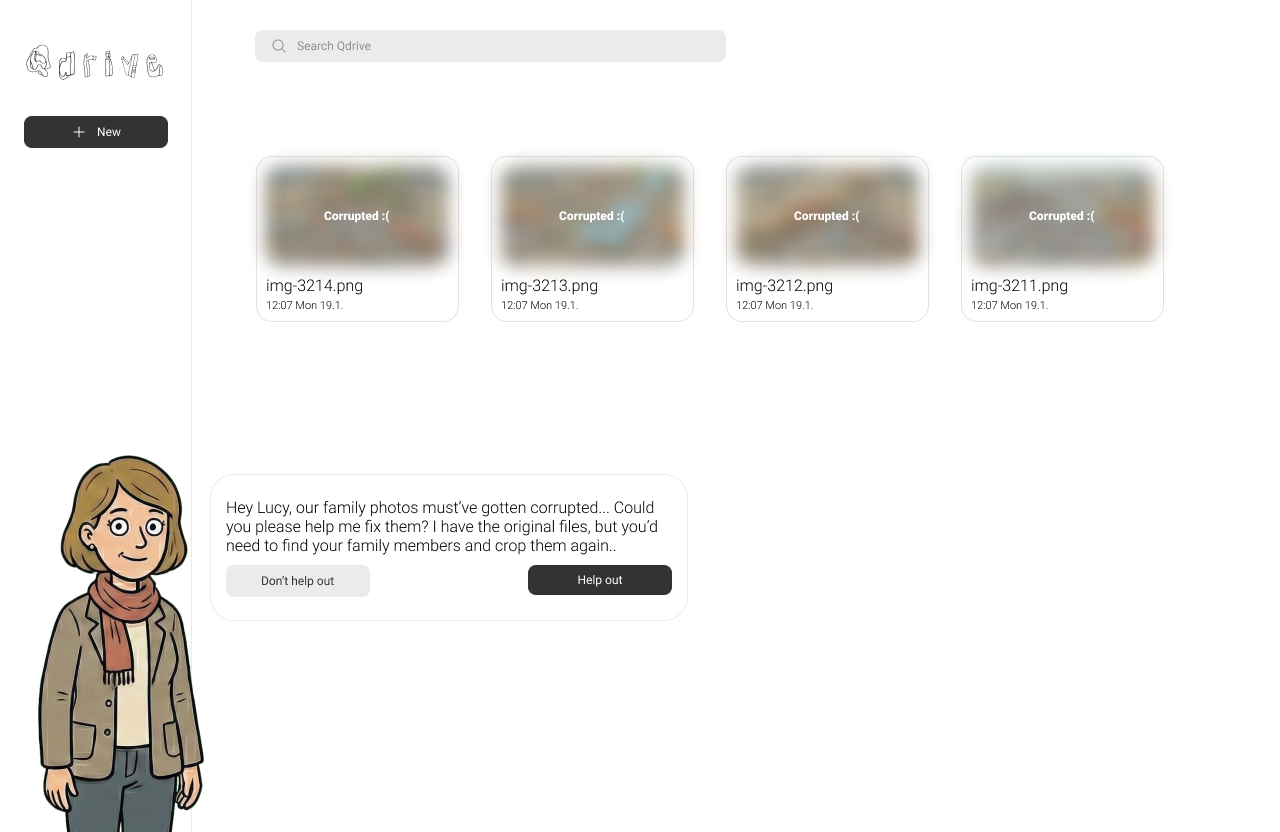
Mid-fi prototype example
- Asset Generation: I used AI to generate detailed, "Where's Waldo" maps of Parisian streets and airport, as well as separate character assets for the family members.
- The "Collage" Technique: By generating the characters and backgrounds separately, we were able to manually place the family members in Figma. This allowed us to fine-tune the difficulty, ensuring the "positive friction" was challenging but not frustrating.
6. Testing & Iteration
Refining the Experience
User testing from the paper prototypes until the mid fidelity versions revealed critical insights that shaped the final design:
Narrative Flow:
Users felt the narrator (Lucy's Mom) appeared too suddenly and lacked context. Therefore we decided to reiterate to find a new solution. In order to establish context, we added an online chat interface making the experience feel more "authentic".
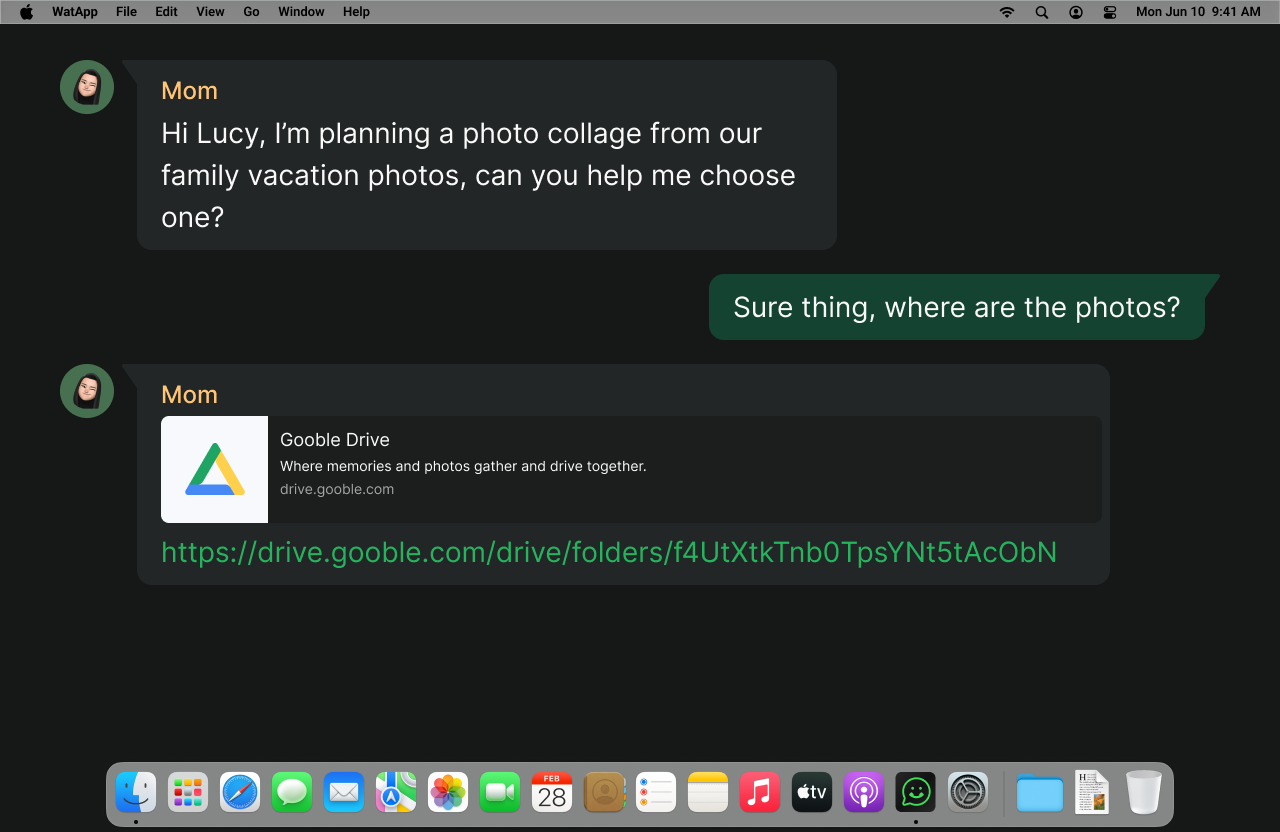
Chat interface example
Authenticity:
Initial testing revealed the experience felt overly game-like, lacking the authenticity needed for a meaningful gift. We addressed this through two key changes: as mentioned before - the chat interface to add conversational context, and framing the entire prototype as a Mac interface with loading screens and system notifications to create a genuine, real-world feel.
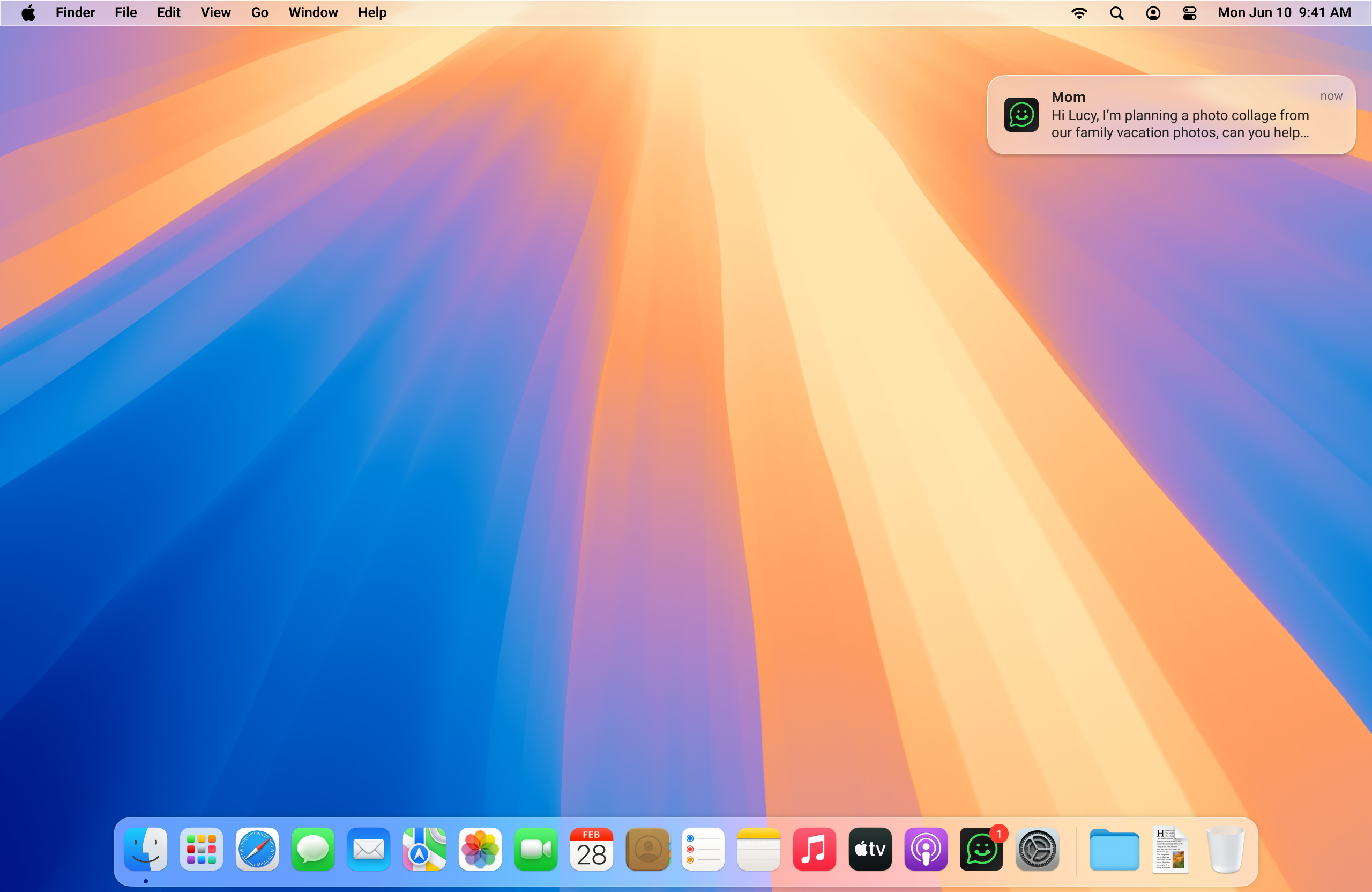
Mock desktop with system notifications example
The Reveal:
In testing, users initially missed the subtle Paris clues. We refined the visual design to better foreshadow the destination, enhancing the "stimulation" and "meaning" of the final reveal.
7. Conclusion
The Result
The final product was a bespoke interactive experience that successfully met the design vision of providing "stimulation" and "authenticity". By forcing Lucy to "earn" her gift, we proved that the giver had "invested time to create a personalized, demanding, and rewarding interaction just for her".
Our group won the "Best Overall Experience" award for this project, which was a testament to how well we executed on the brief and created a truly unique experience that resonated with our user.